
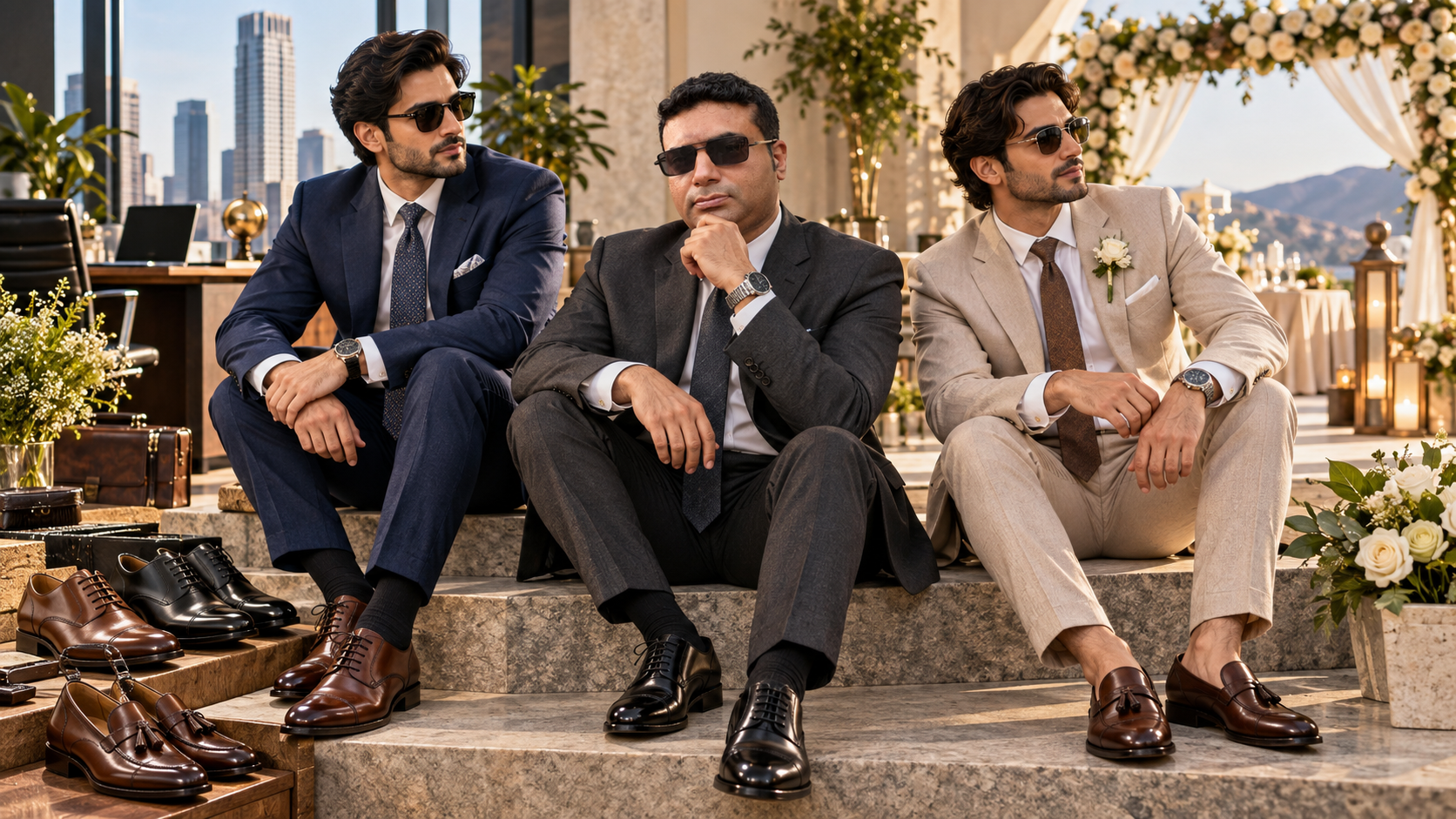

A good dress shoe should be slightly boring.
Not dull. Not cheap-looking. Just dependable enough that you can wear it to an important Monday meeting, pull it out again for a Saturday wedding, and never wonder whether your shoes are fighting with the rest of your outfit.
That is harder to find than it sounds.
Men’s footwear has become more casual over the past decade, yet the occasions that genuinely require proper shoes have not disappeared. Weddings still happen. Interviews still matter. Formal offices still exist. And there are evenings when a pair of sneakers—even extremely expensive ones—simply looks wrong.
Current Esquire guidance makes a similar distinction. Its latest dress-shoe coverage argues that the strongest options combine appearance, construction and actual wearability, while matching the occasion rather than chasing one supposedly universal style. (Esquire) GQ, meanwhile, continues to emphasize traditional materials and construction methods such as full-grain leather, Goodyear welting and Blake stitching when discussing shoes intended to last. (GQ)
For most men, then, the question isn’t “What is the fanciest shoe?”
It is this:
Which pair will look correct often enough to earn its place in the wardrobe?
The Quick Answer: What Should Most Men Buy?
If you own only one serious pair of dress shoes, make it a dark brown cap-toe Oxford or Derby if your wardrobe is mostly navy, charcoal, beige and business casual.
If you regularly wear black suits, attend formal evening events or work in a conservative profession, begin with a black cap-toe Oxford.
That may not be exciting advice.
It is useful advice.
Before getting into individual styles, here is the practical hierarchy.
| Shoe Style | Work | Weddings | Formality | Best With |
|---|---|---|---|---|
| Black cap-toe Oxford | Excellent | Excellent | High | Black, charcoal, navy suits |
| Dark brown Oxford | Excellent | Excellent | High | Navy, grey, brown tailoring |
| Plain Derby | Excellent | Excellent | Medium-high | Suits, tailored separates |
| Penny loafer | Good | Very good | Medium | Chinos, summer suits, relaxed tailoring |
| Tassel loafer | Good | Excellent | Medium | Suits, separates, cocktail dressing |
| Wholecut Oxford | Very good | Excellent | High | Minimal formal tailoring |
| Brogue | Excellent | Good | Medium | Office wear, textured suits |
| Monk strap | Good | Very good | Medium | Contemporary tailoring |
The best choice is determined as much by where you are going as by how much the shoe costs.
1. Black Cap-Toe Oxfords: The Safest Formal Choice
There is a reason the black Oxford keeps surviving fashion cycles.
Its closed lacing creates a clean, narrow-looking front, and a cap toe adds just enough visual structure without making the shoe decorative.
For conservative business dress, interviews, formal ceremonies, evening weddings and funerals, it is difficult to make this shoe look inappropriate.
And that is exactly its strength.
Esquire’s current dress-shoe coverage continues to feature traditional shoemakers such as Crockett & Jones, Allen Edmonds, John Lobb and George Cleverley alongside more contemporary options, suggesting that classic lace-up footwear remains central even as men’s wardrobes become less formal overall. (Esquire)
A black Oxford works particularly well with charcoal and black suits. It is also perfectly comfortable visually with dark navy.
Where it becomes less useful is casual dressing. Pair one with pale chinos and an open-neck linen shirt and the shoe can feel like it arrived from a different event.
Best for: formal offices, important meetings and traditional weddings.
Buy this first if: you frequently wear dark suits.
2. Dark Brown Cap-Toe Oxfords: The Most Useful All-Rounder
For sheer wardrobe mileage, dark brown may beat black.
It still looks polished enough for serious business settings, but brown softens tailoring in a way black cannot.
Wear it with navy.
Medium grey.
Charcoal.
Brown.
Stone trousers.
Even certain olive combinations.
At a daytime or early-evening wedding, dark brown leather often looks more natural than highly formal black shoes, particularly with navy or lighter tailoring.
The crucial word is dark.
Rich espresso or deep chocolate is much easier to use than bright tan if you want one pair to cover both work and weddings.
Tan can look excellent, but it announces itself. Dark brown quietly cooperates.
Best for: the man who wants one high-quality shoe to do almost everything.
3. Plain-Toe Derbies: Better If You Hate Stiff Formal Shoes
The Derby is one of menswear’s great compromises.
It is still a proper leather lace-up, but the open lacing creates a slightly more relaxed appearance than an Oxford.
That small construction difference has practical consequences.
A Derby tends to sit more naturally with business-casual clothing, textured tailoring and less rigid suits. For men with a higher instep, the lacing arrangement can also offer more adjustment across the top of the foot.
At work, try a dark brown Derby with grey trousers and a navy blazer.
At a wedding, pair a sleeker version with a navy or brown suit.
The mistake is buying one with an excessively heavy sole and expecting it to behave like formal evening footwear.
Chunkier Derbies are excellent.
They’re simply playing a different game.
4. Wholecut Oxfords: For the Minimalist
A wholecut is made with an upper formed largely from one continuous piece of leather, which gives the shoe a particularly clean appearance.
GQ has highlighted wholecut Oxfords among modern dress-shoe choices, including versions aimed at men who prefer minimal design. (GQ)
This style works beautifully with sharply tailored suits because there is very little visual interruption.
Black feels formal and architectural.
Dark brown feels slightly softer.
Burgundy can be excellent if you already own the obvious basics.
The downside? Smooth simplicity exposes mediocre leather and poor proportions quickly. There are fewer decorative details available to distract from an awkward last or cheap-looking finish.
Buy a wholecut because you like understatement, not because it sounds more sophisticated.
5. Penny Loafers: Best for Relaxed Offices and Summer Weddings
The loafer has escaped its old preppy stereotype.
It now occupies an extremely useful space between formal footwear and casual shoes.
Esquire’s current guide places considerable emphasis on loafers, including Alden’s tassel styles and the enduring G.H. Bass Weejuns, reflecting how central slip-ons have become to contemporary men’s wardrobes. (Esquire)
A polished dark-brown penny loafer can handle:
business-casual offices, tailored trousers, linen suits, summer weddings and dinner afterward.
That range is impressive.
But context matters.
A beachside wedding in cream tailoring? Excellent.
A highly conservative corporate presentation with a charcoal three-piece suit? Reach for lace-ups.
Loafers look best when the outfit has a little breathing room.
6. Tassel Loafers: The Wedding Shoe Nobody Talks About Enough
Penny loafers are restrained.
Tassel loafers have a little more personality.
That makes them unusually good for weddings.
They work especially well with navy suits, double-breasted tailoring, linen, pleated trousers and cocktail-style outfits.
Suede versions look excellent during the day, though smooth leather is easier to carry into evening events.
Esquire currently singles out Alden’s tassel suede loafer in its broader dress-shoe recommendations, illustrating how a style once associated with traditional menswear has become a versatile contemporary option. (Esquire)
A tassel loafer is probably not your first business shoe.
It could easily become your favorite second or third pair.
7. Brogues: Excellent for Work, Slightly Less Formal for Weddings
One common misunderstanding is treating “brogue” as a shoe shape.
Brogueing actually refers to the decorative perforations found on styles such as Oxfords and Derbies.
The more decoration the shoe carries, the more visually casual it generally feels.
That is why a brown wingtip brogue works beautifully with flannel trousers, tweed, textured suits and business-casual offices.
For a wedding, it depends on the dress code.
A countryside ceremony or autumn wedding? Very natural.
A strict black-tie event? Not the moment.
GQ’s dress-shoe coverage includes brogues among classic wardrobe options and specifically points to established American makers such as Allen Edmonds. (GQ)
If your wardrobe leans traditional rather than minimalist, brogues add useful character without becoming trendy.
8. Monk Straps: A Good Alternative to Another Pair of Oxfords
Monk straps replace laces with one or two buckled straps.
They sit somewhere between conservative and expressive.
A single monk in dark brown leather can still work in an office.
A double monk attracts more attention and feels more fashion-conscious.
For weddings, both are useful because tailoring already gives you permission to dress with slightly more personality than you might on an ordinary workday.
The important detail is the last.
A sleek, restrained monk strap looks elegant.
One with an excessively long pointed toe can look dated remarkably quickly.
If you already own black and brown lace-ups, a monk strap makes more sense than buying another nearly identical Oxford.
9. Patent or Highly Polished Black Shoes: Keep Them for Black Tie
A black-tie invitation changes the rules.
This is not really the occasion for your everyday brown office shoes, no matter how expensive they are.
Traditional black-tie footwear leans toward highly polished black Oxfords, patent-leather Oxfords or formal evening slippers, depending on the level of convention.
The principle is straightforward: tuxedo footwear should disappear into the formality of the outfit rather than introduce a contrasting color.
Do not buy patent shoes as your everyday office pair.
Their specialization is the point.
10. Dress Shoes With Comfort Soles: Useful, With One Condition
Modern dress shoes increasingly borrow cushioning and lightweight sole technology from sneakers.
That can be excellent news for anyone standing through a twelve-hour wedding or commuting on foot.
But some hybrids go too far.
A beautifully shaped leather upper placed on a thick white sneaker sole may be comfortable, but it no longer behaves like a truly versatile dress shoe.
For casual offices? Fine.
For conservative work or formal weddings? Much less convincing.
The sweet spot is a shoe that hides most of its comfort technology.
From the top, it should still look like a dress shoe.
Your feet can know the truth.
Work Shoes and Wedding Shoes Have Different Jobs
A work shoe needs repetition.
You may wear it three times in one week. It needs to cope with walking, commuting, meetings and indifferent office carpets.
A wedding shoe has a different challenge.
It has to survive standing during the ceremony, photographs, dinner and potentially several questionable decisions on the dance floor.
That leads to an important buying rule:
Never wear a new pair for the first time at a wedding.
Give leather shoes several shorter outings first. Wear them at home. Walk to dinner. Take them through half a workday.
Discovering a pressure point during speeches is poor planning.
Black or Brown?
This decision is easier than menswear forums sometimes make it.
Black is more formal.
Dark brown is more versatile.
If your suits are mostly black and charcoal, buy black.
If they’re mostly navy, medium grey and earth tones, dark brown will probably work more often.
If you can afford two pairs, buy both.
That is arguably the entire dress-shoe wardrobe solved for most men.
Tan works best with lighter tailoring and daytime clothing.
Burgundy is surprisingly versatile with navy and grey but makes more sense after the basics are covered.
What Makes a Dress Shoe Worth Paying More For?
Price alone proves very little.
Look instead at leather, construction, shape and whether the shoe can realistically be repaired.
GQ’s guidance specifically identifies full-grain leather, Goodyear welted or Blake construction and resolable soles as signs worth considering when looking for dress shoes designed for longer-term ownership. (GQ)
That doesn’t mean every good shoe has to be Goodyear welted.
Blake-stitched footwear can be sleeker and lighter.
Cemented construction can also make sense at lower prices, particularly if comfort and occasional use matter more than decades of repairability.
The question is whether you’re buying a five-times-a-year shoe or a five-times-a-week shoe.
Those are different investments.
The Most Common Buying Mistakes
The biggest mistake is choosing with your eyes while ignoring your calendar.
A dramatic double monk might look fantastic online but make little sense if you work in a conservative bank.
A black Oxford may be beautifully made but unnecessary if you live in chinos and attend outdoor weddings.
Also avoid buying shoes too long because they feel tight across the width. That creates ugly creasing and heel movement while failing to solve the actual fit problem.
And don’t obsess over the brand before determining the correct size and last.
A prestigious shoe that hurts is still a bad shoe.
Three Simple Shoe Wardrobes
For the minimalist, the answer is one pair:
Dark brown cap-toe Oxford or sleek Derby.
For the man who regularly wears suits:
Black Oxford + dark brown Oxford or Derby.
For someone with a more developed wardrobe:
Black Oxford + dark brown Derby + loafer + one expressive option such as a brogue or monk strap.
After that, you’re collecting rather than solving a problem.
There is nothing wrong with collecting shoes.
Just know when it has happened.
Which Brands Are Worth Knowing?
There is no need to treat one manufacturer as objectively superior for every buyer.
Esquire’s latest guide spans several price and style levels, highlighting heritage names including Alden, Crockett & Jones, John Lobb, George Cleverley, Edward Green, Santoni, Grenson, Allen Edmonds and G.H. Bass, alongside more comfort- and value-oriented options. (Esquire)
GQ similarly mixes traditional luxury makers with more accessible modern labels rather than arguing that good dress shoes exist at only one price point. (GQ)
That is the sensible approach.
Fit first.
Use case second.
Construction third.
Brand fourth.
Reversing that order is an expensive way to discover that famous shoemakers cannot redesign your feet.
The Pair I’d Build a Wardrobe Around
For the widest range of men, I would start with a simple dark-brown cap-toe shoe in smooth leather with a moderately slim round toe and a leather or discreet rubber sole.
Oxford if your life runs formal.
Derby if it doesn’t.
It can go to the office on Tuesday, a wedding on Saturday and dinner the following week without looking as though it belongs exclusively to any one of those situations.
Then add black Oxfords when formal events demand them.
After that?
Loafers get interesting. Brogues become tempting. Monk straps start appearing in browser tabs.
But the first pair should solve a problem, not create a hobby.
The best men’s dress shoes for work and weddings are ultimately the ones that look polished enough for important occasions, feel comfortable enough to stay on your feet and remain restrained enough that you don’t regret buying them three years later.
Good shoes don’t need to rescue the outfit.
They simply make sure nothing looks wrong from the ankles down.
