
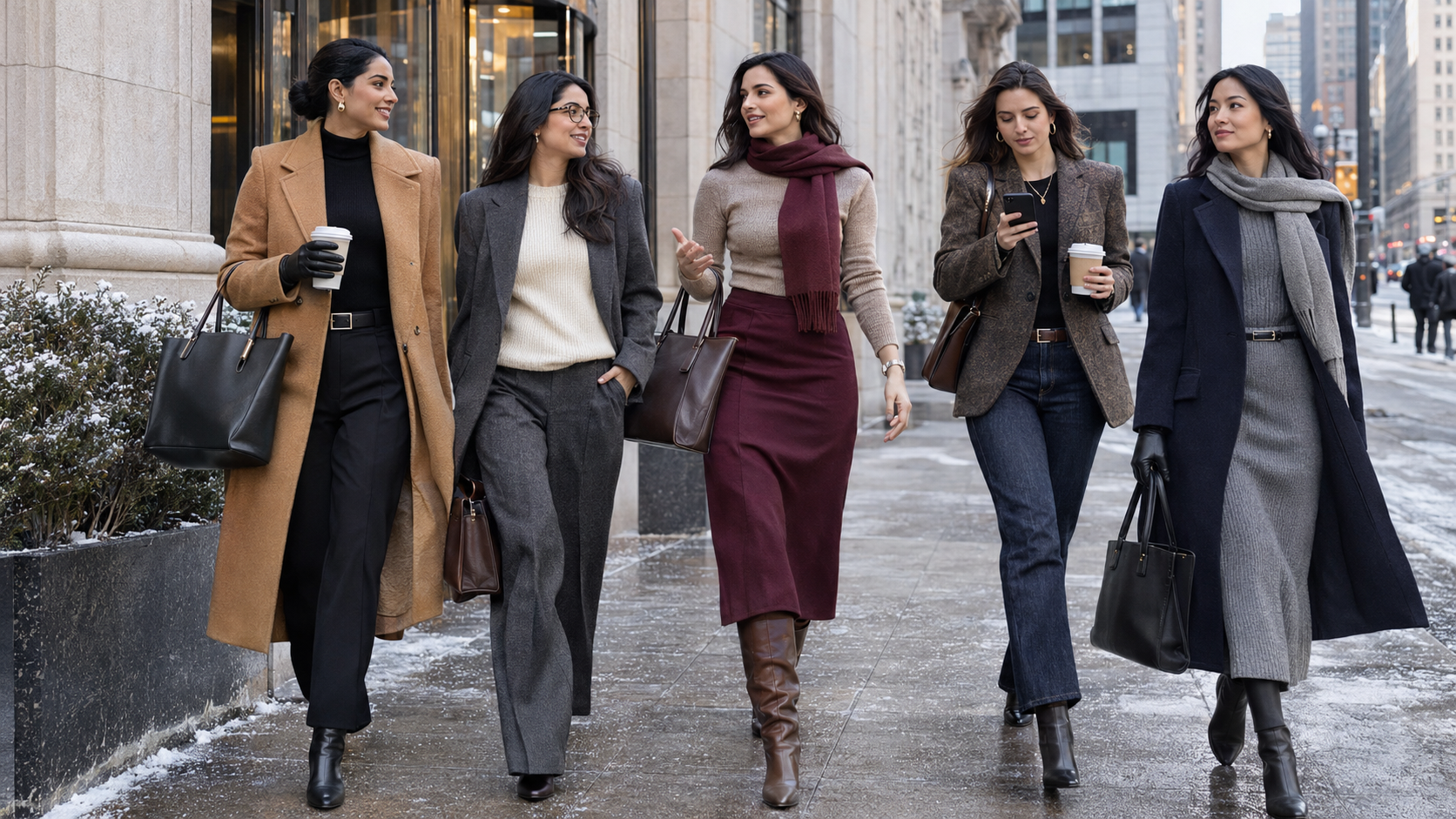

the outfit has to work in two completely different climates.
Outside, it may be 28°F with wind strong enough to make you reconsider employment.
Inside, the office thermostat is apparently preparing for July.
The best winter Outfits solve both problems without making you look as though you wore everything you own at once.
That means layers you can remove. Real outerwear. Shoes capable of surviving a commute. Knitwear thin enough to sit comfortably beneath a blazer. And trousers, dresses and skirts that still look polished once the coat comes off.
For Winter 2026, office dressing is also becoming more interesting. Vogue’s current workwear guidance emphasizes tailored coats, turtlenecks, wool trousers, knit skirts, leather, dark denim and tonal dressing, while Harper’s Bazaar’s latest office coverage points toward rich textures, relaxed tailoring, tweed, deep-indigo denim and polished accessories rather than rigid corporate uniforms.
The useful part?
Most of these ideas do not require an entirely new wardrobe.
They require better combinations.
Winter Work Outfit Cheat Sheet
| Office Situation | Reliable Formula |
|---|---|
| Business formal | Wool coat + suit + knit shell + pumps/boots |
| Business casual | Turtleneck + tailored trousers + loafers |
| Creative office | Midi skirt + knit + statement coat |
| Casual office | Dark denim + blazer + ankle boots |
| Very cold commute | Long coat + layers + trouser + weather-ready boots |
| Client meeting | Column dress + tailored coat + structured bag |
| Friday office | Knit set + boots + long coat |
1. Camel Coat + Black Turtleneck + Tailored Trousers
Start with the winter work uniform that almost never fails.
A long camel coat adds warmth and polish before you even reach the office. Underneath, wear a fine black turtleneck with black or charcoal trousers.
The result is clean without looking severe.
Add:
a structured leather tote,
ankle boots,
and simple gold jewelry.
This works especially well in finance, consulting, law, corporate offices and anywhere a blazer feels appropriate but not mandatory.
The trick is keeping the turtleneck thin enough to layer comfortably.
2. Grey Suit + Fine Knit Instead of a Shirt
A suit feels much better in winter when you replace the crisp button-down with knitwear.
Choose a lightweight merino or cashmere crewneck in:
cream,
burgundy,
navy,
or charcoal.
A grey suit with a soft knit feels less rigid than traditional business tailoring but remains meeting-ready.
Harper’s Bazaar’s recent Fall 2026 office coverage continues to favor complete suits while updating them through texture, color and less conventional styling.
Finish with pointed boots or loafers.
3. Chunky Knit + Fluid Maxi Skirt + Long Coat
This is one of the easiest ways to make comfort look deliberate.
Pair a substantial sweater with a flowing midi or maxi skirt.
Then add a long tailored coat.
Vogue recommends this exact contrast—chunky knitwear with fluid skirts—as a polished winter-work formula, particularly when grounded with loafers or boots and warm hosiery.
Keep the sweater slightly shorter or tuck the front loosely into the waistband so the silhouette still has shape.
Best colors:
charcoal + cream,
chocolate + camel,
navy + grey,
burgundy + black.
4. White Shirt + Chocolate Trousers + Navy Coat
Chocolate brown has become one of the most useful workwear neutrals.
It feels softer than black but still serious.
Wear chocolate tailored trousers with a white or pale-blue shirt and a navy wool coat.
Add a brown belt and loafers.
This combination looks especially good because the colors feel intentional without becoming overly matched.
Who What Wear’s Winter 2026 office guidance also identifies chocolate-brown tailoring as one of the season’s easiest ways to refresh professional wardrobes.
5. Knit Midi Dress + Knee-High Boots
A knit dress is ideal for mornings when constructing an outfit feels unnecessarily ambitious.
Choose a midi or maxi silhouette with enough structure to avoid looking like loungewear.
Good options include:
ribbed column dresses,
belted knit dresses,
or softly fitted turtleneck dresses.
Add knee-high leather boots and a long wool coat.
The boots provide visual weight while keeping most of the leg covered.
This is one of the rare office outfits that can be genuinely warm without feeling bulky.
6. Burgundy Trousers + Pink Shirt + Dark Coat
Winter workwear does not need to mean five months of grey.
Burgundy is especially strong because it behaves almost like a neutral while adding considerably more energy.
Try burgundy trousers with a soft pink button-down.
Vogue specifically recommends pink and red-based combinations as a way to bring color into winter office dressing without abandoning polish.
Keep the coat dark—navy, charcoal or chocolate—to calm the palette.
7. Pencil Skirt + Boxy Blazer + Tall Boots
The pencil skirt has returned without bringing back the uncomfortable office uniform that used to accompany it.
The modern version is longer.
Cleaner.
Sometimes leather or knit.
Pair a below-the-knee pencil skirt with a slightly boxier blazer rather than an overly fitted jacket.
Add knee-high boots so there is no awkward exposed strip of leg between skirt and footwear.
This combination works particularly well for presentations and client meetings.
8. Cream Trousers + Blue Shirt + Shearling or Wool Coat
White and cream trousers should not disappear after Labor Day.
Winter is actually when they can look most sophisticated.
Wear ivory or cream tailored pants with a pale-blue shirt and a warm camel, tan or shearling-style coat.
Vogue’s Winter 2026 office guide specifically makes the case for white trousers as a year-round work staple rather than a warm-weather-only piece.
Black or chocolate boots prevent the outfit from becoming too summery.
9. Dark-Wash Jeans + Turtleneck + Blazer
For offices where denim is acceptable, winter is the perfect time to make it look more professional.
Start with dark indigo or rinse-wash jeans.
Avoid heavy distressing.
Then add:
a fitted turtleneck,
tailored blazer,
leather belt,
and polished ankle boots.
Who What Wear currently favors dark straight-leg denim for office dressing because it reads cleaner and more refined than heavily faded casual jeans.
The jeans are casual.
Everything surrounding them should be deliberate.
10. Head-to-Toe Grey
Monochrome dressing is useful when you want to look polished without thinking too much.
Use several shades rather than one exact color.
For example:
light-grey knit,
charcoal trousers,
mid-grey wool coat.
The difference in texture prevents the look from becoming flat.
Vogue highlights tonal grey, burgundy and winter white as effective ways to make practical winter layers feel more intentional.
Add black footwear for contrast.
11. Tweed Dress + Blazer + Pumps
Tweed immediately makes winter clothing feel more substantial.
Choose a sleeveless or short-sleeve tweed midi dress and layer a blazer over it.
This gives you flexibility once you are inside a warm office.
Harper’s Bazaar’s Fall 2026 workwear guide uses textural tweed as an example of how a straightforward work dress can feel current without becoming trendy.
Keep accessories simple.
The texture is already doing the work.
12. Leather Skirt + Cashmere Sweater
Leather can absolutely work in an office.
Choose a knee-length or midi leather skirt rather than something extremely short or tight.
Pair it with a soft cashmere or merino sweater.
A polished loafer, slingback or knee-high boot finishes the outfit.
Black leather with camel knitwear is classic.
Chocolate leather with cream is even better for Winter 2026.
13. Collarless Jacket + Turtleneck + Tapered Pants
The collarless blazer is becoming an excellent alternative to traditional lapels.
It looks cleaner and slightly more modern.
Wear one over a thin turtleneck with tapered or straight-leg trousers.
Who What Wear identifies collarless jackets as a particularly useful Winter 2026 office layer because they work with both denim and formal trousers.
Add a long pendant or sculptural earrings if the neckline feels too minimal.
14. Pinstripe Suit + Jewel-Tone Blouse
Some workdays call for an actual power suit.
Use pinstripe.
Then make it less predictable with the layer underneath.
Emerald.
Burgundy.
Sapphire.
Deep plum.
Harper’s Bazaar recommends pairing traditional pinstripe tailoring with a jewel-toned blouse for a winter outfit that remains professional without looking corporate in the dated sense.
A pointed boot or pump keeps the silhouette sharp.
15. Pleated Midi Skirt + Oversized Turtleneck
A pleated skirt works particularly well in winter because it moves easily beneath a long coat.
Pair it with a substantial neutral turtleneck.
Try:
cream + chocolate,
grey + burgundy,
black + camel.
Then add tall boots.
The key is balance.
If the sweater is oversized, keep the skirt relatively fluid rather than extremely full.
16. Knit Skirt Set + Long Coat
Matching knit sets are excellent for office mornings when the sun appears approximately three hours after your alarm.
Wear a coordinated knit top and midi skirt.
Then add:
long coat,
knee-high boots,
and a structured work bag.
Vogue recommends knit sets as practical winter office pieces precisely because they make getting dressed simpler while still looking intentional.
Choose fine or medium-gauge knits for the office rather than anything that feels excessively lounge-like.
17. Black Trousers + Satin Blouse + Short Wool Jacket
This works beautifully when you have after-work plans.
Start with black tailored trousers.
Add a satin blouse in:
ivory,
burgundy,
dark green,
or chocolate.
Top it with a short structured wool coat or jacket.
The satin gives the outfit enough evening polish without making it unsuitable for daytime meetings.
Keep jewelry minimal during work hours.
Add stronger earrings later if needed.
18. Navy Trousers + Cream Sweater + Herringbone Coat
This is the quiet winter work outfit that always looks expensive.
Nothing dramatic.
Nothing difficult.
Just:
navy trousers,
cream knit,
grey herringbone coat,
black or brown boots,
structured leather bag.
The trick is fabric quality and proportion.
The coat should be long enough to cover most of the jacket or sweater underneath.
The trousers should break cleanly over the shoe.
Simple clothing becomes much more convincing when the fit is precise.
19. Black Column Dress + Long Coat + Boots
A long-sleeve black midi dress is one of the most versatile winter office pieces you can own.
Wear it under:
camel,
grey,
navy,
or burgundy outerwear.
Add leather boots and a proper work tote.
A pendant necklace or scarf prevents the monochrome base from feeling too severe.
This is particularly useful on presentation days because there is almost nothing to adjust once you arrive.
20. Relaxed Suit + Turtleneck + Loafers
The final outfit is probably the most useful modern office formula.
Choose a slightly relaxed suit—not sloppy, just less rigid.
Wear a fitted turtleneck underneath rather than a blouse.
Then add loafers or sleek boots.
Harper’s Bazaar notes that slouchier tailoring remains part of the modern workwear conversation, while cleaner accessories keep the result office-appropriate.
This works especially well in:
marketing,
tech,
media,
design,
architecture,
and other offices where conventional business formal would feel overdressed.
The Winter Workwear Rule That Matters Most: Build From the Coat Inward
During warm weather, the coat is irrelevant.
In winter, strangers may see your outerwear more than the actual outfit.
So start there.
A useful winter work wardrobe probably needs no more than three strong coats:
one tailored dark coat
Black, charcoal or navy.
one lighter neutral coat
Camel, taupe or cream.
one weather-focused option
For snow, heavy rain or difficult commutes.
Your office outfit should work once the coat comes off, but the outerwear should not look like an afterthought.
How to Layer Without Looking Bulky
Warmth is about intelligent layers, not maximum volume.
Start with something thin:
silk camisole,
heat-retaining base layer,
fine merino turtleneck.
Then add your visible layer:
shirt,
sweater,
dress,
or blazer.
Finish with the coat.
That gives you three temperature levels.
Outside: everything.
Office: coat off.
Overheated meeting room: blazer or sweater off if appropriate.
This is far more practical than one enormous sweater that becomes unbearable indoors.
The Best Winter Work Shoes
The ideal shoe depends on weather and office formality.
The most useful categories are:
ankle boots for trousers and dresses,
knee-high boots for skirts,
loafers for milder winter days,
kitten heels when you need polish without a high heel,
and
weatherproof commuting boots when conditions are genuinely bad.
Do not destroy expensive suede pumps in road salt because an outfit article told you to prioritize aesthetics.
Change shoes at the office if necessary.
People have been doing this in New York, Chicago and Boston for generations for a reason.
Winter Colors That Look Especially Good at Work
The strongest Winter 2026 office palette is deeper rather than simply darker.
Think:
burgundy
chocolate
charcoal
forest green
navy
aubergine
Then use:
cream,
winter white,
camel,
or pale blue
to lighten them.
Harper’s Bazaar’s 2026 winter workwear coverage similarly emphasizes burgundy, black, grey and aubergine as elegant seasonal colors that fit naturally into professional wardrobes.
What Makes a Winter Work Outfit Look Expensive?
Usually not the price.
Three things matter more.
Fit.
Trousers should sit correctly.
Coats should have clean shoulders.
Sleeves should end where they are supposed to.
Texture.
Wool, leather, suede, silk, cashmere and good knits make simple outfits visually richer.
Restraint.
If the coat is dramatic, the bag can be quiet.
If the trousers are burgundy, the blouse doesn’t also need feathers.
One strong choice is usually enough.
Build a 10-Piece Winter Work Capsule
You do not need 20 entirely different wardrobes to create 20 outfits.
A highly functional winter work capsule could contain:
a long dark coat, camel coat, black trousers, grey trousers, dark denim, midi skirt, black dress, white shirt, turtleneck and one good blazer.
Then rotate:
boots,
loafers,
scarves,
bags,
belts,
and jewelry.
That is where most of the variation comes from.
The clothes repeat.
The styling changes.
Which is how people with genuinely good wardrobes usually dress anyway.
Final Take: Professional Does Not Have to Mean Predictable
Winter office dressing becomes much easier once you stop treating warmth and style as competing goals.
Wool trousers are warm.
So are midi skirts with tights.
A long coat is useful and visually strong.
Knee-high boots are practical.
A turtleneck is basically made for layering beneath tailoring.
The strongest winter work Outfits for 2026 are not radically different from classic office wardrobes.
They are simply better styled.
The trousers are a little more relaxed.
The coat matters more.
Burgundy replaces another black item.
Leather appears beside cashmere.
Denim is dark and intentional.
And comfort no longer has to be hidden.
If I were building a winter office wardrobe from zero, I would start with three pieces:
a great long coat,
a pair of beautifully fitting trousers,
and
a thin turtleneck.
Everything else becomes much easier after that.
FAQs
What should I wear to work in winter?
Start with warm professional layers such as a fine turtleneck or knit, tailored trousers or a midi skirt, and a structured wool coat. Boots, warm hosiery and a practical work bag can make the outfit winter-ready without sacrificing polish.
Can jeans be professional enough for winter work outfits?
Yes, if your workplace allows denim. Choose dark-rinse or deep-indigo straight-leg jeans without heavy distressing and pair them with a blazer, knitwear, polished boots or loafers and a structured coat.
How can I stay warm at work without looking bulky?
Use several thin layers rather than one oversized layer. A lightweight thermal or camisole beneath fine merino knitwear, followed by a blazer and wool coat, provides warmth while allowing you to remove layers indoors.
Feature Image Direction — 1280 × 720
No readable company names, no visible logos, no text and no watermark. Final size: 1280 × 720 px.
Authority references: Vogue — Winter Work Outfit Ideas · Harper’s Bazaar — Winter Work Outfits · Who What Wear — Winter 2026 Office Trends
