
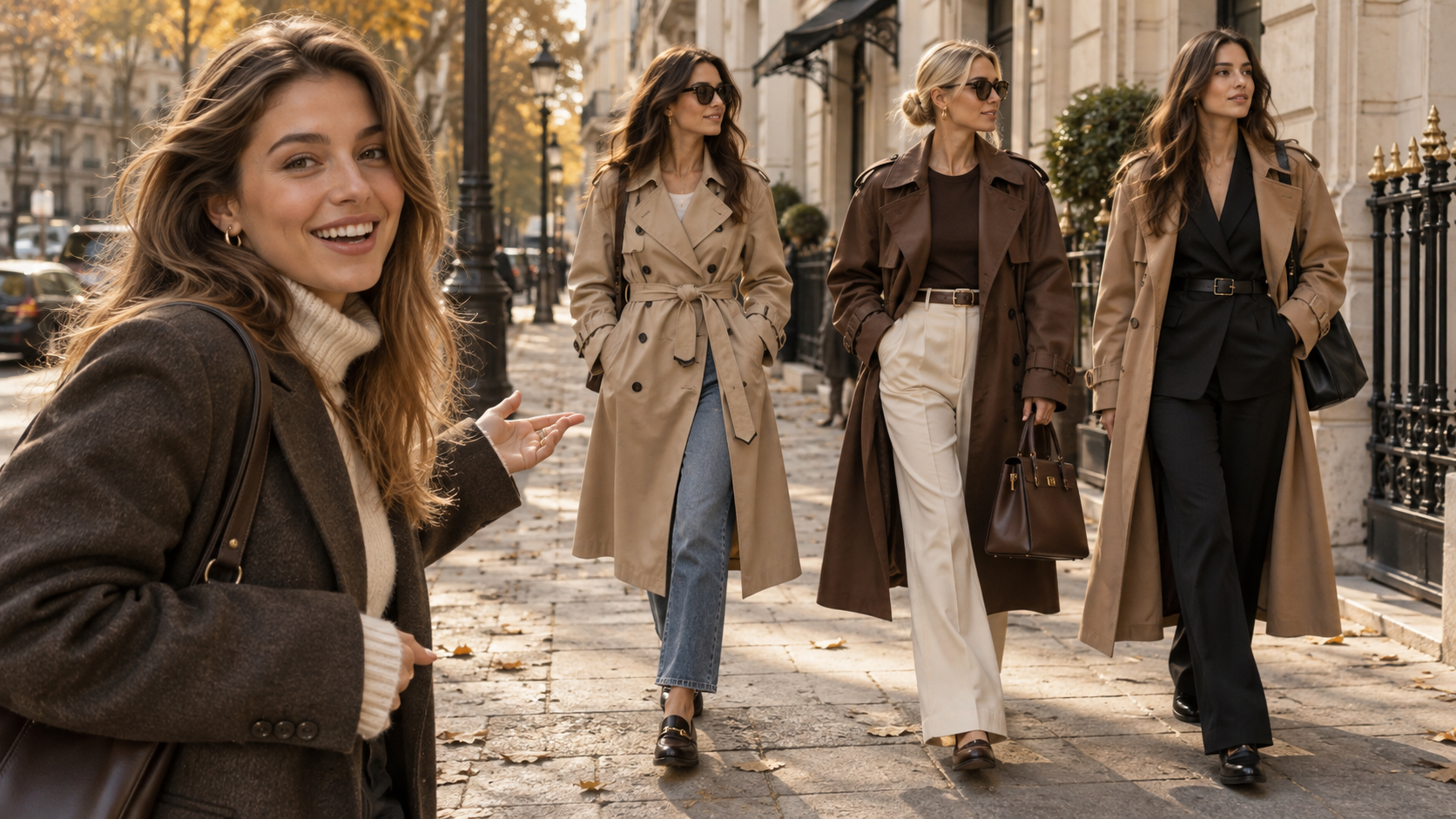

There are coats you buy because they’re having a moment.
Then there’s the trench.
It survives changing hemlines, questionable denim eras, minimalist wardrobes, maximalist wardrobes and practically every version of “quiet luxury” fashion has invented. A good trench can sit over a suit on Monday, jeans on Saturday and a knit dress when the weather can’t decide what season it is.
That’s what makes buying one surprisingly important.
You aren’t necessarily looking for the most dramatic coat in your wardrobe. You’re looking for the one you can reach for without thinking.
For 2026, designers are giving the classic shape more room to move. Traditional beige versions are still everywhere, but longer proportions, oversized silhouettes, cropped cuts, suede, leather and cleaner Mac-style coats have expanded the category considerably. Vogue’s current edit ranges from accessible Gap, Levi’s and Mango options through COS and contemporary labels to investment pieces from Burberry, Toteme, The Row and Saint Laurent. (Vogue)
So the best trench coats for women aren’t all trying to do the same thing.
Some are built for rainy commutes. Some are essentially elegant fall coats. Some are fashion pieces. And one or two are the sort of purchase you expect to still be wearing ten years from now.
A few current styles across the price spectrum:
What Actually Makes a Good Trench Coat?
Start with fabric rather than buttons.
Traditional trench coats are associated with tightly woven cotton gabardine, a fabric developed by Thomas Burberry in the late 19th century. Its combination of durability and weather resistance helped turn the coat from practical outerwear into the enduring wardrobe piece we know today. (Vogue)
Modern trenches use everything from cotton twill and cotton blends to polyester, wool, suede and leather.
For an everyday coat, cotton or a cotton-blend fabric is usually the easiest choice. It has enough structure to create the recognizable trench silhouette while remaining wearable across spring and fall.
Then look at weight.
A very thin trench can work beautifully in mild weather, but it may wrinkle easily and won’t provide much warmth. A heavier cotton twill feels more substantial and often hangs better.
Finally, check the details.
A classic trench usually includes a double-breasted front, storm flap, belted waist, cuff straps and sometimes epaulettes.
You don’t need all of them.
Actually, removing a few details can make the coat look more modern.
Best Budget Pick: Mango’s Classic Trench
You don’t need to spend four figures to get the trench-coat effect.
Mango is particularly good at this category because its coats tend to borrow the proportions of higher-end fashion without becoming too experimental to wear three years later.
A long belted trench in beige, stone or khaki is the safest choice.
Current Vogue recommendations include Mango among the accessible traditional trench options alongside Gap, with the publication highlighting the continued usefulness of classic beige, double-breasted and belted silhouettes. (Vogue)
What I like about this price level is that you can experiment slightly.
Maybe you aren’t certain you’ll wear a full-length trench every week. Spending a moderate amount makes more sense than immediately jumping into heritage-luxury territory.
Wear it with straight jeans, a fine knit and loafers.
Nothing complicated.
That’s precisely why it works.
Another Affordable Option: A Simple Mac-Style Coat
Not everyone wants buckles, epaulettes, storm flaps and a belt hanging somewhere near their knees.
If that’s you, look at a Mac.
The silhouette is related to the trench but cleaner: usually single-breasted, straighter and less decorated.
Levi’s Frankie trench is among Vogue’s current more accessible minimalist selections. The appeal is versatility rather than visual drama. (Vogue)
A simple Mac looks excellent over business clothes because it doesn’t compete with what’s underneath.
Black trousers. White shirt. Loafers. Coat.
Done.
It also works particularly well for shorter women who feel overwhelmed by the amount of fabric and hardware on a traditional oversized trench.
Best Mid-Range Direction: Everlane’s Relaxed Trench
Everlane’s trench coats tend to make sense for women who want classic styling without an overly formal silhouette.
The useful word here is relaxed.
A little extra room through the shoulders means you can layer a sweater or blazer underneath without turning your arms into restricted airspace.
Harper’s Bazaar has recently pointed to Everlane’s interpretation as a contemporary alternative to more traditional Burberry proportions, noting its relaxed cut and slightly shorter approach. (Harper’s BAZAAR)
This type of trench is particularly useful if your normal wardrobe consists of jeans, trousers, sweaters and simple shirts rather than formal dresses.
It looks polished without making everything underneath feel as though it has suddenly been invited to a business meeting.
J.Crew for the Polished Classic
J.Crew sits in an interesting position.
Its best trench coats tend to feel more traditional than fashion-forward, which is exactly what some buyers should want.
If you’re building a wardrobe rather than collecting trends, a clean tan or khaki version with good proportions can last through years of styling changes.
Harper’s Bazaar currently includes J.Crew among the full-length trench options it considers strong enough to carry through rainy transitional weather. (Harper’s BAZAAR)
This is the sort of trench I’d pair with navy trousers, a white shirt and brown loafers for work, then wear open over jeans and sneakers the next day.
A trench earns its space when you stop saving it for specific outfits.
Best Cropped Trench: COS
The cropped trench shouldn’t make sense.
You’re taking a garment famous for coverage and chopping half of it off.
Yet the proportions can be excellent.
COS does especially well with architectural shapes, dropped shoulders and cleaner detailing, so its shorter trenches tend to look intentional rather than simply shortened.
Harper’s Bazaar has highlighted cropped COS trench styling for transitional layering, while Vogue’s current trench guide also treats shortened versions as a significant category for 2026. (Vogue)
Cropped trenches work particularly well with high-waisted trousers and wider jeans because they allow more of the leg line to remain visible.
For petite women, that’s useful.
For anyone who already owns a classic long trench, it’s also a way to add a second coat without essentially buying the first one again.
The Oversized Trench: More Useful Than It Looks
Oversized doesn’t have to mean enormous.
A well-cut oversized trench simply gives the fabric room to move.
The shoulders may sit slightly lower, the body falls straighter and the hem often reaches below the knee. Worn open, it creates a long vertical line that’s surprisingly flattering.
This direction continues to appear in 2026 fashion, with Vogue noting oversized trench treatments on the Fall 2026 runways, including at Celine. (Vogue)
The trick is balance.
If the trench is very loose, keep at least part of the outfit underneath relatively clean.
Wide trench + enormous scarf + oversized trousers + giant handbag can become a lot of geometry.
Try it over a fitted knit and straight trousers first.
Best Minimalist Luxury Pick: Toteme
Toteme’s appeal is almost the opposite of a highly traditional heritage trench.
The detailing is quieter.
The silhouette and fabric do the talking.
At the luxury end, Toteme also appears in Vogue’s current trench edit with a draped interpretation designed to move from daytime tailoring into evening dressing. (Vogue)
This makes sense for someone whose wardrobe already leans minimal.
If you wear black trousers, cream knits, straight denim, ballet flats, loafers and understated leather bags, an aggressively traditional military-inspired trench may introduce more detail than you want.
A cleaner Toteme-style coat disappears into the wardrobe more naturally.
That’s luxury you actually wear.
The Heritage Investment: Burberry
Eventually, every trench-coat conversation reaches Burberry.
There’s a reason.
The brand’s history is fundamentally connected with gabardine and the development of the trench coat, and its heritage designs still establish the reference point that many other labels reinterpret. (Vogue)
The Kensington is the kind of coat people consider when they want one trench rather than a rotation of them.
The expense is substantial.
So don’t buy it because trench coats are trending this fall.
Buy something at this level only if you’ve already learned that the trench silhouette genuinely fits your life.
If you’ve spent the last five years wearing an affordable beige trench into the ground, then upgrading to a Burberry begins to make much more sense.
You already know you’ll use it.
What About The Row and Saint Laurent?
At this point we’re no longer really discussing value.
We’re discussing design.
The Row strips coats back until proportion, fabric and construction become the luxury. Vogue’s current edit includes its Dayton coat among minimalist Mac-style options, alongside more elaborate designer interpretations from Saint Laurent, Khaite and others. (Vogue)
Saint Laurent takes a different route.
Its trenches often feel sharper, darker and more dramatic. The brand also appears in current edits with both alternative-color gabardine versions and suede interpretations. (Vogue)
Neither is necessary.
That’s important.
You don’t buy a coat at this level because it performs the basic job of a trench five times better than a mid-range one.
You’re paying for material, cut, construction, design language and, yes, the label.
If those things matter to you, excellent.
If they don’t, save the money.
Suede Trench Coats Are Having a Moment
This is where the category becomes genuinely different.
A suede trench isn’t really a raincoat anymore.
Please don’t stand in a downpour testing that theory.
Instead, think of it as luxurious fall outerwear.
Vogue’s current 2026 selection includes suede coats from COS, Nour Hammour, Arma and Saint Laurent, reflecting the broader move toward brown, rust and tactile outerwear. (Vogue)
Chocolate suede looks especially good with cream denim, black trousers and blue jeans.
The texture does most of the styling for you.
Because suede is already visually rich, keep everything else fairly simple.
Should You Buy Black, Beige or Brown?
If this is your first trench, buy beige.
Not because fashion law requires it.
Because beige does the best job of showing the details that make a trench interesting, and it works with black, navy, denim, white, olive, burgundy and brown.
Black is better if your wardrobe is predominantly monochrome or you want something sharper for work.
Brown is particularly good right now, especially in chocolate or espresso tones, but it also has enough longevity to survive beyond 2026.
Olive deserves consideration too.
It’s neutral without looking quite as expected.
How Long Should a Trench Coat Be?
There is no universally flattering length.
There is a useful one for your wardrobe.
Mid-thigh trenches feel casual and work well with jeans.
Knee-length versions are the easiest all-rounders.
Midi and calf-length trenches have more drama and look excellent with wide trousers, long skirts and dresses.
Floor-grazing versions are increasingly fashionable, and current luxury collections include intentionally extended silhouettes. (Vogue)
Just remember that your actual life contains stairs, escalators, rain and occasionally dirty pavements.
Fashion photographs do not always include these complications.
How Should a Trench Coat Fit?
Try it over clothing.
This sounds obvious, yet people regularly test coats over one thin T-shirt and then discover in November that a sweater barely fits underneath.
The shoulder should give you enough movement without collapsing excessively.
Button the coat.
Tie the belt.
Put your hands in the pockets.
Sit down.
Raise your arms.
Walk around.
A trench doesn’t need to fit like tailoring. In fact, slightly more room usually makes it look better.
Pay special attention to sleeve length.
Sleeves that finish awkwardly above the wrist can make an otherwise expensive coat look strangely small.
How to Make an Affordable Trench Look Expensive
Fit comes first.
Steam it.
Seriously.
A beautifully styled £100 trench covered in shipping-box creases will look cheaper than it needs to.
Next, don’t overtighten the belt.
Either tie it loosely at the front or knot it behind you when wearing the coat open.
Keep the layers underneath relatively simple.
A beige trench over a black turtleneck, straight dark denim and loafers already has enough visual information.
Then look after the coat.
Clean cuffs, neat buttons and fabric that hasn’t been left crushed beneath six winter jackets matter more than a designer label from ten feet away.
Which Trench Coat Should You Actually Buy?
For a first trench, I’d stay classic.
Choose beige or stone, knee to mid-calf length, with enough room for knitwear and a fabric substantial enough to hang properly.
Mango, Gap, Levi’s, Everlane and J.Crew all occupy useful territory before serious luxury spending begins, and contemporary brands such as COS offer more directional proportions. Current fashion editors are recommending options across exactly this range rather than treating the trench as a luxury-only purchase. (Vogue)
If you already own the classic version, that’s when things become more interesting.
Try cropped.
Try oversized.
Try chocolate brown.
Try suede.
Or invest in a cleaner luxury interpretation from Toteme.
And if you have worn trench coats consistently for years and want the heritage reference itself, Burberry remains the obvious destination.
The best trench coats for women aren’t necessarily the most expensive ones.
They’re the coats that become slightly invisible in your wardrobe.
You stop planning outfits around them.
You just put one on.
Over jeans when it’s raining.
Over work trousers on a cool morning.
Over a dress at dinner.
Then one day you realize you’ve owned it for eight years.
That’s usually how you know you bought the right trench.
