
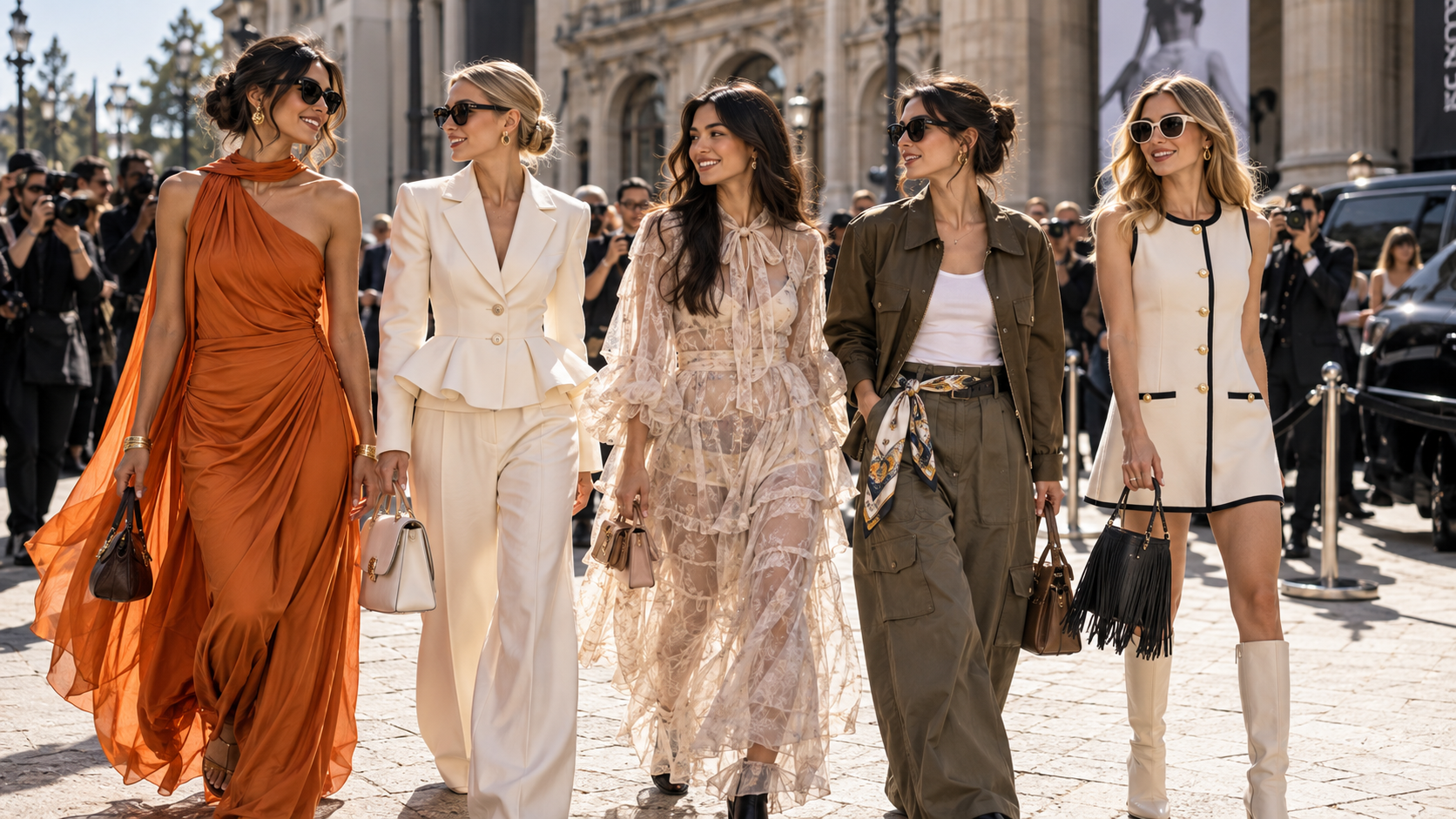

Fashion has spent several seasons trying very hard to look effortless.
Neutral trousers. Perfect blazers. Expensive-looking knitwear. Tiny gold earrings. Handbags designed to whisper rather than announce themselves.
Spring/Summer 2027 appears increasingly uninterested in behaving that way.
The early runway season is pointing toward clothes with more movement, more color and, frankly, more personality. New York Fashion Week has already made the case for playful dressing through fringe, scarf belts, mod minis and punchier color, while Vogue Business’s broader Spring/Summer 2027 forecast is tracking a retreat from the tightly controlled “clean girl” aesthetic toward draping, sheers, utility references, orange and a renewed interest in sculpted waists. (ELLE)
There is one useful caveat.
As of September 20, 2026, New York is complete and London is still unfolding, while Milan and Paris are yet to come. So this is best read as an early Spring/Summer 2027 trend report, not the final verdict on fashion month.
Still, some ideas are already becoming difficult to ignore.
And unlike hyper-specific runway experiments that disappear before reaching stores, these ten have enough commercial momentum and styling flexibility to make the jump into actual wardrobes.
1. Fashion Is Getting Messier—On Purpose
This may be the most important trend because it affects how everything else is worn.
Perfect coordination is beginning to look a little tired.
Vogue Business describes the emerging mood as a form of “free-style expression”: clashing colors, mixed prints, layered tanks, sheer overlays, graphic tees and footwear that deliberately does not seem to belong to the rest of the outfit. Retail data cited in the report also shows growing interest in spotted and striped clothing, supporting the broader move toward more pattern mixing. (Vogue)
This does not mean dressing badly.
It means dressing less predictably.
Picture a floral skirt with a striped shirt.
A delicate dress with sportswear.
A pastel cardigan over a graphic T-shirt.
A polished handbag with shoes that look slightly wrong.
That final part is important.
For several years, outfits were designed to look resolved. Every color connected neatly to another. Every accessory appeared selected as part of a set.
Spring 2027 wants a little friction.
And because this approach does not require buying a completely new wardrobe, it is one of the trends most likely to spread quickly.
2. Draped “Modern Goddess” Dressing
Draping is having one of those moments where it suddenly feels less like formalwear and more like everyday design.
Vogue Business identifies a “Modern Goddess” direction for Spring/Summer 2027 built around asymmetric skirts, wrapped fabrics, embellished details, chain belts and softer, flowing silhouettes. It also notes rising product-description references to draping in both tops and dresses. (Vogue)
The easiest version is not a floor-length Grecian gown.
It is much simpler.
A jersey top twisted at one shoulder.
A skirt gathered diagonally at the hip.
A soft dress that falls unevenly across the body.
A white draped blouse with loose trousers.
A slinky column dress under a sharply cut blazer.
The best part is movement.
After several seasons of rigid silhouettes and sharply controlled tailoring, this looks softer without becoming shapeless.
Expect the trend to work especially well in eveningwear and resort dressing first, then move into jersey tops, dresses and skirts at more accessible price points.
3. Sheer Romance Is Staying
If you were waiting for transparent clothes to disappear, Spring 2027 is not your season.
Sheer dressing is becoming less of a red-carpet shock tactic and more of a layering technique.
Vogue Business expects lightweight transparent fabrics, lace, babydoll silhouettes and lingerie-influenced pieces to remain important, but in a softer, more everyday form rather than purely occasionwear. (Vogue)
That makes the trend much more wearable.
Think:
A sheer skirt over briefs or shorts.
A transparent blouse beneath tailoring.
Lace camisoles layered with oversized jackets.
Fine mesh over a slip dress.
Sheer sleeves added to an otherwise simple silhouette.
The interesting part is contrast.
A romantic dress looks fresher with boots.
A lace top feels less precious under workwear.
A transparent skirt paired with a plain cotton tank suddenly becomes daytime clothing.
That tension is likely to be much more influential than simply wearing something see-through.
4. Orange Is Trying to Replace the Neutral Palette
Fashion has apparently had enough brown.
At least temporarily.
Vogue Business has singled out orange as one of the strongest Spring/Summer 2027 color predictions, with lighter shades such as amber and yellow-orange expected to increase in visibility. (Vogue)
New York also gave us plenty of evidence that strong color is returning. ELLE’s Spring 2027 NYFW trend report described the season as playful, highlighting punchy primary shades across designers including LII, Carolina Herrera and Zankov. (ELLE)
Orange works because it can go in several directions.
Bright tangerine feels sporty.
Burnt orange works almost like a neutral.
Coral feels softer.
Amber looks surprisingly sophisticated with cream.
And blood orange is excellent with chocolate brown.
If an orange dress feels like too much, accessories will probably become the easiest entry point.
A small orange bag against gray tailoring may end up doing more work than an entire brightly colored outfit.
5. The Peplum Is Back—But More Sculptural
Some fashion trends return exactly as we remember them.
The peplum is thankfully not doing that.
Spring 2027’s version is less about a small ruffle around the waist and more about creating shape.
Vogue Business points to renewed interest in peplum-led dressing, particularly defined waists combined with volume through jackets, tops and matching separates. (Vogue)
Think architectural rather than sweet.
A jacket that narrows sharply at the waist before flaring over the hips.
A knitted top with a sculpted lower half.
A fitted waist paired with wide trousers.
Corsetry influencing the shape without looking like lingerie.
This is part of a larger reaction against oversized everything.
After years of deliberately loose silhouettes, fashion is rediscovering the waist.
The easiest way to wear it will probably be with very simple bottoms.
Peplum jacket.
Straight trousers.
Minimal shoes.
Let the silhouette do the work.
6. Utility Dressing Is Becoming More Refined
One of Vogue Business’s stranger trend names is “gardening-core.”
Ignore the name if you must.
The clothes themselves make sense.
The forecast includes aprons, raffia, cargos, check shirts, utility belts and workwear-inspired pieces. Retail data cited by Vogue Business shows increased arrivals of cargo styles, utility belts and raffia accessories, suggesting that practical-looking fashion still has considerable room to grow. (Vogue)
But Spring 2027’s utility won’t necessarily look rugged.
Instead, expect polished interpretations.
Cargo trousers in fluid fabric.
Workwear jackets cut like tailoring.
Large functional pockets on dresses.
Apron-style panels over skirts.
Raffia combined with leather.
Belts that look as though they might carry tools but are actually carrying nothing more useful than a tiny decorative pouch.
The appeal is that these pieces look useful.
After an era of extremely delicate handbags and highly polished basics, functionality has become its own aesthetic.
7. Fringe Is About to Move Again
Fringe is one of the clearest trends to emerge from New York so far.
ELLE reported it across Spring/Summer 2027 collections from Kallmeyer, Simkhai, TWP and Monse, where it appeared on knitted gowns, handbags and Grecian-inspired tops. (ELLE)
This is not necessarily western fringe.
It is movement.
Long strands along a skirt.
Fine fringe around a knit.
A scarf trailing at the waist.
A bag that moves when you walk.
The reason fringe works so well for spring is simple: it photographs beautifully and adds drama without relying on heavy fabric.
It also fits neatly into the season’s wider rejection of stiffness.
Draping moves.
Fringe moves.
Scarves move.
The clothes are beginning to behave less like architecture and more like clothes again.
For everyday dressing, a fringed handbag or scarf may be enough.
You do not need to arrive at lunch looking like a curtain in motion.
8. The ’60s Mini Is Back in the Conversation
One of New York’s strongest runway references was the 1960s.
ELLE identified “Mini Mod” as a major Spring 2027 trend, pointing to micro-minis, swing dresses, graphic color blocking and shift silhouettes from designers including Michael Kors, LII, Carolina Herrera and Zankov. (ELLE)
The appeal isn’t difficult to understand.
After years of long hemlines and oversized shapes, a short, clean shift dress looks surprisingly direct.
The new version can be playful without becoming costume-like.
Think:
A-line mini dresses.
Structured shift shapes.
Graphic color combinations.
High necklines balanced by short hems.
Simple flats or minimal heels.
The styling matters.
Instead of making the entire outfit retro, wear the mini with modern accessories.
A contemporary shoulder bag.
Simple sunglasses.
A sleek sandal.
That keeps the reference clear without making it look like you are attending a themed party.
9. Scarves and Cummerbunds Are Moving to the Waist
Spring 2027 may finally convince people to stop wearing belts only as belts.
ELLE’s New York report highlighted two related styling ideas: scarf belts and the return of the cummerbund as a waist-defining accessory. Designers used silk and fringed scarves wrapped around the waist, while cummerbund-style bands moved out of traditional formalwear and into much more casual looks. (ELLE)
This feels especially relevant because it connects several larger trends.
Defined waists.
More draping.
Less rigid styling.
Accessories used in unexpected ways.
A scarf tied around jeans gives a familiar outfit a different proportion.
A broad satin sash over a simple dress creates shape.
A cummerbund worn with trousers makes tailoring feel less corporate.
It is also wonderfully accessible.
You probably already own a scarf.
Fashion loves a trend that can be recreated without shopping.
Even if retailers might prefer otherwise.
10. Oversized Details Are Replacing Oversized Everything
The interesting shift isn’t that oversized clothing has disappeared.
It hasn’t.
But designers are beginning to concentrate volume into specific details instead of simply making the entire garment enormous.
ELLE’s NYFW report notes supersized shirt cuffs as one of the season’s playful proportions, alongside scarves, fringe and more exaggerated styling choices. (ELLE)
That idea has much broader potential.
Large cuffs.
Extended sleeves.
Exaggerated collars.
Balloon trousers.
Billowing tops.
One oversized element attached to an otherwise controlled silhouette.
Vogue Business also points to the continued strength of balloon pants, citing a sharp increase in sell-through compared with previous seasons. (Vogue)
This creates a much more interesting proportion than simply wearing a giant blazer over equally giant trousers.
One part expands.
The rest stays quiet.
It feels deliberate rather than shapeless.
What Spring/Summer 2027 Is Really About
The individual trends matter.
But the bigger change is easier to see when you put them together.
Messy styling.
Sheers.
Draping.
Fringe.
Orange.
Peplums.
Scarves tied somewhere unexpected.
Utility details.
Short mod dresses.
None of these belong to the restrained, highly coordinated wardrobe that dominated the earlier quiet-luxury period.
That does not mean minimalism is disappearing.
It means it no longer has the room to itself.
Vogue Business’s forecast is explicit about the shift: consumers and designers are moving toward stronger self-expression, greater experimentation and a willingness to take up more visual space. (Vogue)
New York’s completed shows appear to support that direction, with ELLE describing the overall season as unusually playful and centered around the simple pleasure of getting dressed. (ELLE)
That may be Spring/Summer 2027’s most useful trend of all.
Clothes are becoming fun again.
Which Trends Will Actually Reach the High Street?
Not everything on the runway translates.
The most likely commercial winners are probably the ones that require the least commitment.
Orange accessories will be easy.
Sheer layers are already familiar.
Draped tops and dresses work across price points.
Peplum jackets give retailers a recognizable new silhouette.
Utility trousers and raffia accessories already have momentum.
Scarves worn as belts cost almost nothing to adopt.
Fringe should also travel well into bags, skirts and occasionwear.
The more editorial ideas—extreme mod minis or exaggerated cuffs—may remain stronger in fashion-forward circles before filtering into everyday wardrobes in quieter forms.
That is normally how trends spread.
The runway rarely arrives in stores exactly as it appeared.
It gets translated.
Don’t Buy All 10 Trends
This should go without saying.
But fashion content occasionally gives the impression that a new season requires deleting your wardrobe and starting again.
It doesn’t.
Choose the ideas that already make sense with how you dress.
If you live in tailoring, try a peplum jacket.
If your wardrobe is mostly neutral, add orange.
If you wear dresses, try draping or a mod shift.
If you prefer jeans, tie a scarf around the waist.
If you love romantic clothing, the sheer trend will be easy.
If you hate all of those ideas, continue wearing what you already own.
Fashion will survive.
The Season Isn’t Finished Yet
One final note matters for anyone following fashion month closely.
These Spring/Summer 2027 fashion trends are emerging from early-season forecasting, Copenhagen, the completed New York shows and the opening stretch of London.
Milan and Paris still have their say.
Those cities may confirm these directions.
They may complicate them.
And they may introduce something completely unexpected that becomes the defining look of Spring 2027.
That uncertainty is part of why fashion month remains interesting.
But the early message is already unusually consistent.
Spring/Summer 2027 does not want to be perfectly coordinated.
It wants movement.
Color.
Shape.
Texture.
And a little bit of chaos.
After several years of wardrobes built around looking effortlessly expensive, that may be exactly what fashion needed.
