
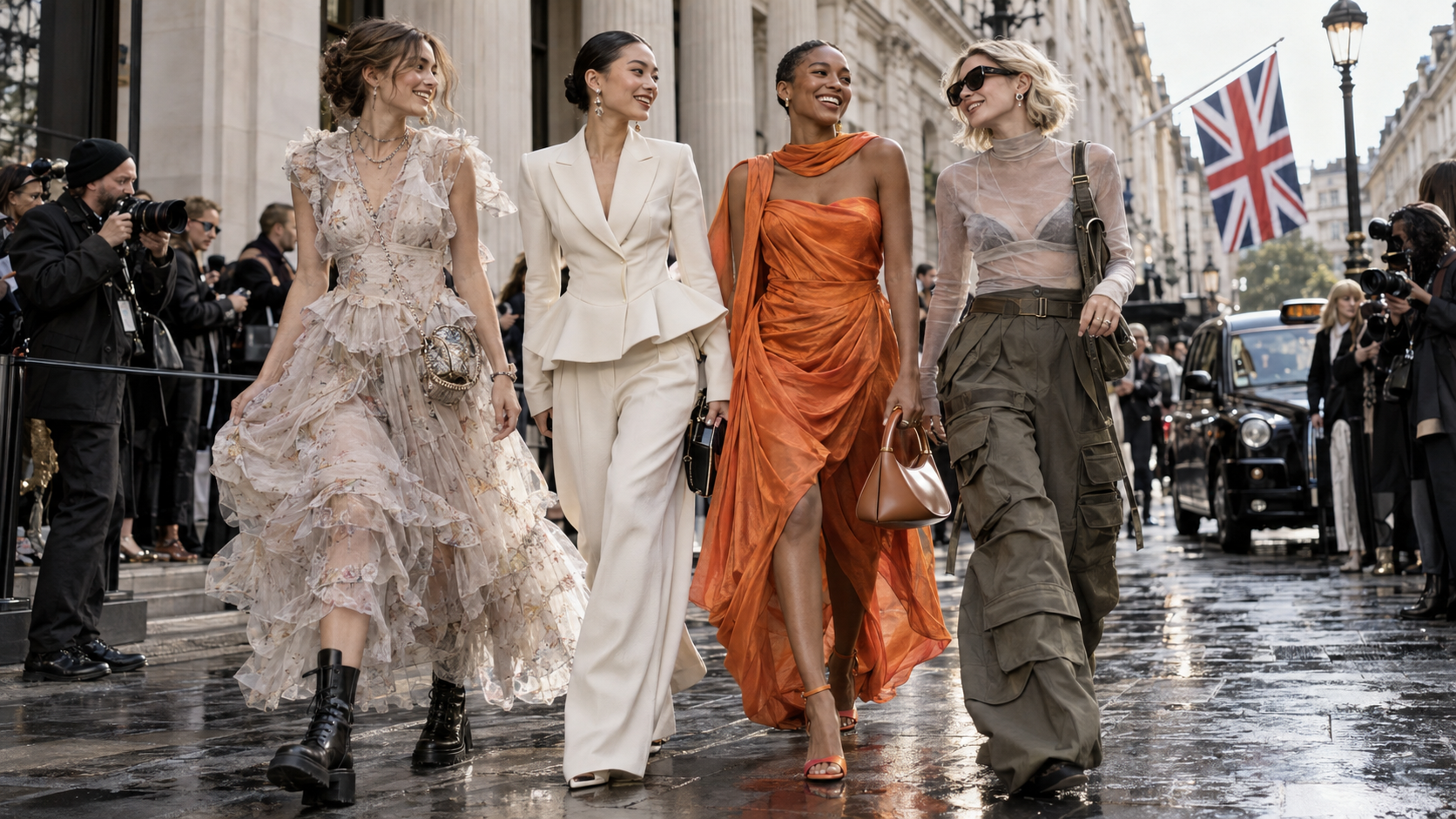

Because London Fashion Week Spring/Summer 2027 has not started yet—it runs September 17–21, 2026—it would be misleading to present these as confirmed runway trends. The strongest SEO/editorial version right now is a pre-fahion-week trend forecast based on the Spring 2027 direction already emerging and the London designers scheduled to show. (London Fashion Week)
London has never been particularly good at following fashion rules.
That’s usually a compliment.
While Milan can make even experimentation look polished and Paris has a talent for turning ideas into mythology, London tends to leave a few seams visible. The city likes a strange proportion, an awkward shoe, a dress that looks romantic from ten meters away and slightly dangerous when you get closer.
That matters for Spring 2027.
London Fashion Week returns from September 17 through September 21, with a schedule that includes established names such as Burberry, Simone Rocha, Erdem and Roksanda alongside NewGen designers, plus two particularly closely watched moments: McQueen’s return to London and Christopher Kane’s first collection for Mulberry. (Vogue)
The actual collections are still a few days away. So this isn’t a pretend runway report.
Instead, it’s a look at the fashion ideas already building momentum for Spring/Summer 2027—and the ones London is especially well positioned to complicate, exaggerate or completely misbehave with.
If the early direction of the season tells us anything, minimalism is losing some of its grip.
Things are about to get more interesting.
1. Romantic Dressing Is Getting Less Delicate
Romance isn’t disappearing.
It is getting stranger.
Spring 2027 predictions are already pointing toward sheer fabrics, transparent layering, soft draping, babydoll shapes and what Vogue has called a broader return to romantic fantasy and “whimsymaxxing.” (Vogue)
London should be very comfortable here.
This is a city where romantic clothing rarely stays sweet for long.
Think of the way Simone Rocha can take lace, bows, pearls and transparent fabric and give them enough tension that they stop feeling innocent. Or how emerging London labels frequently pair something delicate with something deliberately rough.
For Spring 2027, the interesting version of romance probably won’t be a simple chiffon dress with pretty shoes.
It will be:
Sheer skirts over visible shorts.
Lace under leather.
Soft dresses with substantial footwear.
Transparent layers beneath oversized tailoring.
Ribbons and floral details used in ways that feel slightly excessive rather than polite.
The key word is contrast.
After several years of carefully restrained dressing, fashion seems ready to let clothes look emotional again.
That should suit London just fine.
2. Draping and the “Modern Goddess” Look Are Building Momentum
Draped clothing is one of the strongest early Spring 2027 ideas.
Vogue’s seasonal forecast identifies a “Modern Goddess” direction built around flowing fabric, wrapped silhouettes, asymmetric draping and more ethereal materials. (Vogue)
Don’t imagine literal Grecian costume.
The more interesting interpretation is cleaner.
A single shoulder exposed.
Fabric wrapped across the waist.
Long jersey dresses falling unevenly around the body.
Liquid satin.
Twisted necklines.
Soft fabric held against sharper tailoring.
This could become particularly relevant in London because the city has several designers who are good at creating tension between structure and movement.
The strongest versions will probably look easy from a distance while being surprisingly engineered up close.
That’s important.
The return of draping isn’t really about dressing like an ancient statue.
It’s part of a bigger move away from clothes that feel digitally perfect.
Wrinkles, gathers, twists and folds remind you that fabric is actually touching a body.
After years of clean lines, that’s starting to feel fresh.
3. The Peplum Is Back, but Don’t Panic
Yes.
The peplum.
Before everyone starts remembering business-casual tops from 2012, the Spring 2027 version looks much less straightforward.
Current seasonal forecasting points to the peplum as one of the silhouettes positioned for a return, but the modern versions are likely to focus on construction and proportion rather than a small ruffle sewn around the waist. (Vogue)
Think:
Sculpted hips.
Extended jacket hems.
Corseted waists opening into volume.
Short tops with architectural flares.
Tailoring that deliberately exaggerates the relationship between shoulder, waist and hip.
That makes the trend much more interesting.
London designers have never needed much encouragement to distort a silhouette.
A peplum at London Fashion Week could become less about “feminine dressing” and more about geometry.
The most wearable version?
A fitted jacket with a controlled flare over straight trousers.
You don’t need to look like a lampshade to participate.
4. Orange Could Become the Color Everyone Suddenly Owns
Spring fashion often brings bright color.
The interesting question is which one survives beyond the runway.
For 2027, orange is currently one of the strongest candidates.
Vogue’s Spring/Summer 2027 predictions single it out as a potential headline color, reflecting a broader appetite for louder dressing after seasons dominated by restrained neutrals. (Vogue)
London is unlikely to approach orange quietly.
Expect possibilities ranging from sharp citrus to burnt orange, tangerine and almost-red shades.
The easiest version will probably be accessories.
An orange handbag against charcoal tailoring.
Bright shoes beneath a cream dress.
A knit layered into an otherwise neutral outfit.
But London being London, somebody will almost certainly send out a full orange look and make the rest of us reconsider everything.
The useful thing about orange is that it doesn’t have to look summery.
Burnt versions work beautifully with brown.
Clearer orange looks strong against black.
And softer coral-orange can replace the predictable pastel palette usually associated with spring.
5. “Messy Girl” Styling May Replace Perfect Minimalism
This might be the most important shift of the season.
The clean-girl era isn’t necessarily dead.
It just looks tired.
Spring 2027 trend forecasting is already pointing toward deliberately imperfect styling: clashing prints, inconsistent layers, DIY details, more visible personality and outfits that look assembled rather than optimized. (Vogue)
London has been doing versions of this forever.
Vintage with designer.
Romantic dresses with old leather jackets.
School-uniform references next to punk.
Expensive tailoring with something that looks as though it was found in a market five minutes earlier.
The point isn’t to look untidy.
It’s to stop looking algorithmically coordinated.
For several years, fashion feeds have rewarded highly controlled palettes: cream trousers, beige jacket, black bag, gold hoops.
Perfectly fine.
Also increasingly predictable.
Spring 2027 looks ready to make room for the person who adds a strange scarf, wrong shoe or clashing bag because they like it.
London will probably take that permission further than most cities.
6. Utility Dressing Is Getting Softer
Another early Spring 2027 idea is what Vogue calls gardening-core—a slightly humorous name for a broader return to practical dressing, natural materials, aprons, utility pockets, raffia, cargos and workwear references. (Vogue)
Don’t expect everyone to look ready to repot tomatoes.
The interesting part is the mixture of usefulness and romance.
Cargo trousers with sheer tops.
Workwear jackets over delicate dresses.
Apron-like panels built into skirts.
Utility belts used as fashion rather than equipment.
Canvas next to silk.
Raffia bags carried with tailoring.
This makes sense after several years of ultra-polished minimalism because practical details give clothing more texture.
They also give designers something to play with.
London’s version is likely to feel less like country lifestyle branding and more like somebody borrowed gardening clothes, cut them apart and reconstructed them at art school.
Which is probably exactly what will happen somewhere.
7. Tailoring Is Becoming Less Corporate
Tailoring isn’t going away.
It’s loosening up.
Spring 2027 is unlikely to abandon suits, but the rigid office uniform feels increasingly irrelevant to the way fashion is moving.
Instead, expect:
Dropped shoulders.
Long jackets.
Unusual closures.
Soft trousers.
Exposed underlayers.
Jackets over transparent dresses.
Waists pulled in with belts or corsetry.
Suiting worn with pieces that would once have been considered completely incompatible.
This direction suits London particularly well because British tailoring offers designers a traditional structure to dismantle.
McQueen’s return to London will be especially interesting in this context.
The house has always had a complicated relationship with tailoring—precise construction, extreme shape and a tendency to make formal clothing feel psychological rather than simply respectable. McQueen’s Spring 2027 return is one of the major moments on the upcoming calendar. (Vogue)
Whether the collection actually follows this direction remains to be seen.
But if tailoring gets stranger this season, London is the place to watch.
8. Texture May Matter More Than Print
Fashion has spent a lot of time talking about print.
Spring 2027 may be more interested in surface.
Lace.
Fringe.
Embroidery.
Open knits.
Raffia.
Crinkled fabric.
Feathers.
Beading.
Distressed finishes.
The overall movement toward more expressive dressing naturally encourages texture because it adds visual complexity without requiring an obvious graphic print.
This could become especially strong in London because craftsmanship and hand-finished detail remain important across both established labels and younger designers.
A simple dress can become much more memorable when the fabric does something unexpected.
The same applies to accessories.
One tactile bag may have more impact than an entire printed outfit.
9. Sheer Clothes Are Becoming Day Clothes
Transparency has been around long enough that calling it a new trend would be slightly dishonest.
What’s changing is how normal it’s becoming.
Sheer fabric is increasingly functioning as a layer rather than an occasion statement.
A transparent skirt over underwear or shorts.
A sheer blouse beneath tailoring.
A fine mesh dress layered over another dress.
Translucent knitwear.
This moves the idea away from red-carpet exposure and into ordinary styling.
London will likely make it less glamorous and more practical—or at least pretend to.
Throw a trench over it.
Add boots.
Layer a men’s shirt underneath.
Suddenly sheer clothing doesn’t feel precious at all.
That is probably how the trend survives.
10. Accessories Will Get More Personal
If clothing becomes more individual, accessories have to follow.
The heavily coordinated bag-and-shoe approach is already giving way to something looser.
Spring 2027 is likely to continue emphasizing:
Unexpected belts.
Scarves.
Charms.
Layered jewelry.
Soft bags.
Raffia.
Vintage-looking accessories.
Shoes that deliberately interrupt the outfit.
This is where the “messy” movement becomes easiest to try.
You don’t need a completely new wardrobe.
Tie a scarf differently.
Carry a bag that doesn’t perfectly match.
Add an old brooch.
Wear a delicate dress with a heavier shoe.
That kind of styling is particularly relevant in London, where personal dressing has always been part of the spectacle outside the shows as much as what’s happening on the runway.
Why London Matters More This Season
The clothes themselves aren’t the only reason to watch.
The September 2026 schedule has unusual energy around it.
McQueen is returning to London for Spring/Summer 2027 under Seán McGirr, a homecoming the house has explicitly linked to London’s creative identity. (Vogue)
Christopher Kane is also presenting his first Mulberry collection, while established London names and a large emerging-designer contingent fill out the schedule. The British Fashion Council has positioned this season as a combination of returning British houses and newer creative talent. (Vogue)
That combination matters.
Big houses can create global moments.
Young designers create the ideas everyone else starts using later.
London needs both.
And when the two are happening during the same week, trend spotting becomes much more interesting.
What Won’t Matter Until We See the Clothes
Fashion prediction has limits.
Orange may appear everywhere.
Or barely appear at all.
Peplums may dominate.
Or three designers may use them and suddenly every trend report will claim a revolution occurred.
That is why the actual runway matters.
The useful thing to watch isn’t whether one designer uses a sheer dress.
It’s repetition.
If Simone Rocha, several NewGen designers and another major house all approach transparency differently, then we have something.
If several collections distort waistlines, that’s a signal.
If orange keeps appearing from Thursday through Monday, pay attention.
A trend is rarely one look.
It’s an idea that keeps returning.
Spring 2027 Looks Ready to Feel More Human
That may be the larger story.
Fashion has spent several years becoming extremely controlled.
Quiet luxury.
Clean minimalism.
Perfect basics.
Neutral wardrobes.
Clothes designed to look expensive without revealing too much personality.
Spring 2027 appears ready to loosen that grip.
The early signals point toward draping, romance, utility, color, texture, peplums and intentionally imperfect styling. (Vogue)
In other words, clothes may start looking like somebody actually chose them rather than assembled them according to a formula.
London should enjoy that.
This city has never been at its best when everything matches perfectly.
So while the Spring 2027 London Fashion Week trends won’t be confirmed until the shows actually begin on September 17, the direction is already becoming clearer.
Less perfection.
More personality.
More fabric doing strange things.
More color.
More contradiction.
And, if London behaves like London, probably at least one idea nobody predicted at all.
That’s the one worth waiting for.
