
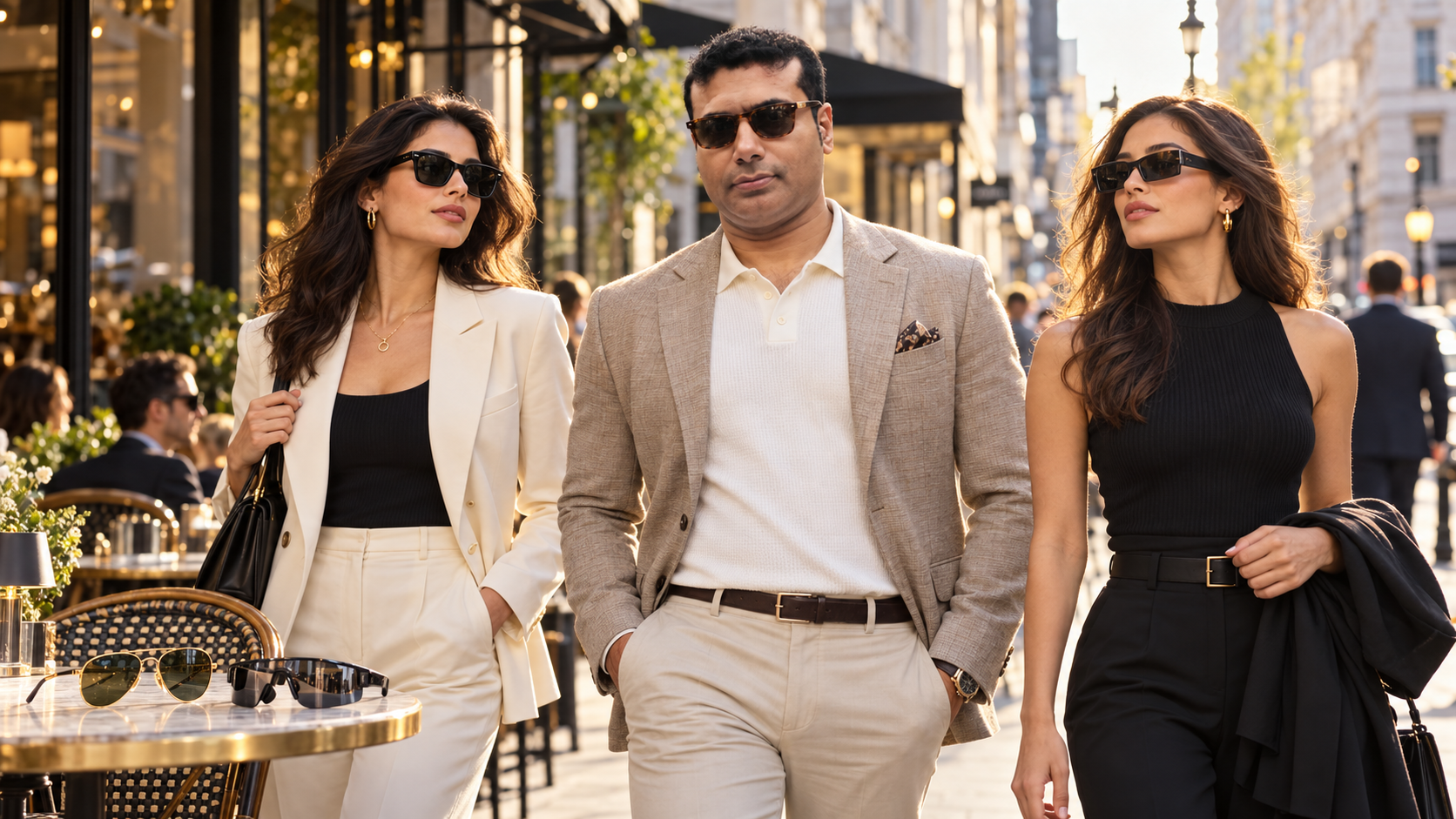

Sunglasses have an unusual ability to make a $30 T-shirt look deliberate.
They also have an unusual ability to disappear in taxis, get crushed inside tote bags and somehow acquire a scratch precisely in the center of one lens.
That makes spending serious money on them slightly complicated.
A $900 frame may be beautifully made, but it is not automatically nine times better for your life than a $100 pair. At the other end, buying the cheapest option available can mean poor fit, uncomfortable hinges and a pair you stop wearing after three weeks.
The useful question is not simply, “What are the best sunglasses brands?”
It is:
Which brands give you something meaningful for the extra money?
GQ’s 2026 sunglasses guide covers this spectrum unusually well, ranging from accessible Warby Parker and Akila frames to heritage names such as Ray-Ban and Persol, specialist performance eyewear from Oakley and small-batch luxury from Jacques Marie Mage. Its editors say their selections are evaluated around quality, fit and price rather than brand recognition alone. GQ
Esquire’s latest 2026 edit makes a similar point: good sunglasses are both eye protection and a style purchase, and higher-quality frames become worthwhile when you actually wear them frequently. Esquire
That last part matters.
The best pair is usually the one that spends more time on your face than in its case.
The Best Sunglasses Brands at a Glance
| Brand | Best For | Price Position | Main Strength | Main Trade-Off |
|---|---|---|---|---|
| Ray-Ban | Best overall | Mid-range | Iconic, versatile shapes | Very common |
| Persol | Heritage luxury | Premium | Italian character and detailing | Costs considerably more |
| Warby Parker | Best value | Accessible | Clean styles at approachable prices | Less artisanal feel |
| Oakley | Sports/performance | Mid-range | Technical fit and performance | Sporty aesthetic |
| Moscot | Vintage-inspired style | Premium | Distinctive New York heritage look | Strong design identity |
| Randolph Engineering | Aviators | Premium | Serious metal-frame construction | Less variety in fashion shapes |
| Oliver Peoples | Quiet luxury | Luxury | Understated, refined design | Expensive for subtle styling |
| Garrett Leight | Everyday premium | Premium | Relaxed California classics | Pricey for understated frames |
| Chimi | Fashion-forward value | Mid-range | Contemporary shapes and color | More trend-sensitive |
| Jacques Marie Mage | Luxury splurge | Ultra-luxury | Small-batch craftsmanship | Very expensive |
There is no reason everyone needs the most expensive brand in this table.
Quite the opposite.
1. Ray-Ban: The Safest Place to Start
If someone wants one pair of sunglasses and does not particularly want sunglasses to become a hobby, Ray-Ban remains difficult to argue against.
The brand has several shapes that have survived decades rather than seasons: Wayfarers, Aviators and Clubmasters among them. GQ’s 2026 brand guide continues to treat the Original Wayfarer as the obvious classic, while Esquire also places the Wayfarer among its core summer recommendations. GQ
Why are they worth paying for?
Mostly because the designs are proven.
You do not have to wonder whether a dramatic new frame will look dated in two summers. A black Wayfarer has already survived enough fashion cycles to answer that question.
Ray-Ban makes particular sense if you:
want one everyday pair, prefer recognizable classics, or are buying better sunglasses for the first time.
The disadvantage is equally obvious.
Everybody knows them.
If individuality is part of what you are paying for, keep reading.
Ray-Ban RB2140 Wayfarer Sunglasses · 4.7AED 550.00 · Amazon.ae – Seller + others
2. Persol: When You Want a Classic That Feels Less Obvious
Persol occupies an interesting position.
It is recognizable to people who care about eyewear but less ubiquitous than Ray-Ban.
The Italian brand’s frames tend to have more visual detail, and GQ highlights Persol for combining old-school style with durability and functional design. Its PO0649 remains one of the brand’s most recognizable aviator-style frames. GQ
Persol works especially well if your wardrobe leans toward:
linen shirts, knit polos, tailoring, suede jackets, loafers and slightly old-school menswear.
The frames often feel less sporty and more cinematic.
That does not mean everybody needs to pay the premium.
If you lose sunglasses every summer, Persol may simply make losing them more emotionally complicated.
Persol PO0649 Sunglasses · 4.8AED 592.63 · Ottica IT + others
3. Warby Parker: Probably the Smartest Value Choice
This is where the value argument becomes much easier.
Warby Parker sits well below traditional luxury eyewear pricing while still offering designs that look considered rather than disposable.
GQ’s current brand guide highlights the company specifically as an accessible alternative to more expensive eyewear and includes several sunglasses well below the pricing of premium European brands. GQ
For most shoppers, that makes Warby Parker appealing for a very practical reason:
you can buy a good-looking pair without spending an amount that makes leaving them at a restaurant feel like a minor financial crisis.
The styles generally lean clean and wearable rather than aggressively experimental.
That’s a strength if these are your daily sunglasses.
If you are looking for hand-finished Japanese acetate and obsessive small-batch detailing, however, this is not really the category.
Warby Parker is about getting the equation right.
Good design.
Reasonable cost.
Low drama.
Warby Parker Raider SunglassesAED 293.76 · Afshar Optics
4. Oakley: Worth It When Performance Actually Matters
Oakley makes much less sense if your only requirement is looking good at brunch.
It makes far more sense if you run, cycle, hike, play outdoor sports or spend long periods in conditions where fit matters.
Esquire’s 2026 recommendations describe Oakley’s performance frames around lightweight construction and grip-focused materials designed to keep sunglasses secure during movement. GQ likewise places the brand firmly in the technical-performance category rather than treating it as another fashion label. Esquire
That distinction is important.
Do not pay for sports technology you do not need.
But if sunglasses slide down your face during every run, the practical improvements become much easier to justify.
Oakley has also become fashionable again beyond sport, particularly through wraparound and technical frames.
Still, performance remains the reason I would buy them.
Oakley Radar EV Path Sunglasses · 4.7AED 517.42 · Ottica IT + others
5. Moscot: Best for Vintage Character
Some sunglasses disappear into an outfit.
Moscot frames often become part of your face.
The New York eyewear house is particularly good at thick acetate and vintage-inspired silhouettes, with the Lemtosh becoming its signature style.
GQ calls the Lemtosh one of the most universally wearable options in its 2026 sunglasses-brand roundup, while Esquire’s current edit also includes Moscot among its summer choices. GQ
Moscot makes sense if you like:
classic American clothing, vintage references, creative-professional style or frames with more identity than an anonymous black rectangle.
There is a risk.
A strong frame can overpower someone who prefers extremely subtle accessories.
Try them on if possible.
Sunglasses live directly in the middle of your face. This is one purchase where half an inch matters.
MOSCOT LEMTOSH Sunglasses · 4.7AED 1,640.00 · moscot.com + others
6. Randolph Engineering: The Aviator Specialist
If you specifically want aviators, specialist brands become more interesting than general fashion labels.
GQ’s 2026 guide singles out Randolph Engineering as a strong aviator option, with the brand’s metal frames occupying a more serious, utilitarian position than many fashion-first versions. GQ
The appeal is straightforward.
These look like aviators because aviation is central to the brand’s visual language, not because somebody decided aviators happened to be trending that season.
Choose Randolph if you want:
thin metal frames, classic proportions and a pair you expect to wear for years.
Skip them if you like constantly changing silhouettes.
Their strength is consistency.
7. Oliver Peoples: Quiet Luxury Done Properly
Oliver Peoples does not usually shout.
That is why people who notice eyewear often notice it.
The brand started in Los Angeles in the late 1980s and developed around vintage-inspired American eyewear. GQ’s current guide highlights its premium materials and restrained retro design. GQ
This is a good brand for someone whose wardrobe already follows a quiet-luxury logic:
beautiful fabric, subtle tailoring, no enormous logos.
The sunglasses tend to work the same way.
The question is whether you value subtlety enough to pay for it.
To somebody who doesn’t care about acetate quality, finishing or small design details, a $500 understated frame can look surprisingly similar to a $120 understated frame.
That does not make the expensive one pointless.
It simply means the value is in details you have to appreciate.
8. Garrett Leight: California Without the Costume
Garrett Leight offers a slightly easier, younger version of premium classic eyewear.
GQ describes the Los Angeles label as taking familiar shapes and giving them a distinctly West Coast character. Its current selections sit comfortably in the premium category without reaching the extremes of artisanal luxury brands. GQ
This is where I would look if you want sunglasses that feel stylish without visibly trying to be “fashion sunglasses.”
Tortoiseshell.
Soft squares.
Classic acetates.
Colors that work with ordinary clothes.
The brand makes particular sense if you wear sunglasses frequently enough for craftsmanship and comfort to matter but do not want them to dominate every outfit.
9. Chimi: Fashion Without the Full Designer Markup
Not everybody wants heritage.
Sometimes you simply want sunglasses that look current.
Chimi fills that space well.
Both GQ and Esquire include the Swedish label in their 2026 coverage, highlighting contemporary shapes, clean rectangular frames and more accessible pricing than many traditional luxury eyewear houses. GQ
Chimi is especially useful if you like changing sunglasses with fashion rather than treating one frame as a ten-year investment.
Black rectangles.
Tinted lenses.
More playful proportions.
The trade-off is that fashion-driven shapes may date sooner than a Wayfarer or aviator.
That’s fine.
Not every purchase needs to become an heirloom.
10. Jacques Marie Mage: When “Worth It” Means Something Different
Now we reach the dangerous part of the conversation.
Jacques Marie Mage sunglasses can cost more than some people’s entire summer wardrobes.
Are they necessary?
Of course not.
Are they interesting?
Very.
GQ’s 2026 guide notes that the Los Angeles-based label produces frames by hand in Japan in small numbered batches. Esquire’s current edit also includes the brand as its high-end fashion choice. GQ
That changes the value equation.
You are not paying merely for sun protection.
You are paying for:
limited production, design, unusual proportions, finishing and exclusivity.
For someone deeply interested in eyewear, that might be worth it.
For somebody who throws sunglasses loose into a gym bag?
Absolutely not.
Luxury only becomes value when you care about the thing being made luxurious.
How Much Should You Actually Spend?
There is a useful way to divide sunglasses into four categories.
Under roughly $100: ideal for travel backups, experimentation and people who lose sunglasses regularly.
Around $100–$250: probably the best value zone for most shoppers.
Around $250–$500: premium construction, stronger brand identity and better materials become more relevant.
$500 and beyond: you are increasingly paying for design, craftsmanship, materials, small-scale production and luxury positioning.
Those are not quality guarantees.
A more expensive frame can still fit your face badly.
A cheaper pair can become the one you wear five days a week.
That brings us to the number that actually matters.
Think in Cost Per Wear
Imagine Pair A costs $150 and you wear it 200 times.
That is 75 cents per wear.
Pair B costs $600 and you wear it 20 times.
That is $30 per wear.
Suddenly the cheaper sunglasses look like the luxury purchase.
This is why buying a neutral, flattering shape usually makes more financial sense than chasing whatever sunglasses happened to dominate fashion week this month.
Spend more on the pair you will repeatedly reach for.
Spend less on experiments.
What Actually Makes Sunglasses Worth More?
Forget the logo for a moment.
Pay attention to:
Fit. They should stay comfortably on your nose without painful pressure behind the ears.
Hinges. Cheap hinges can loosen quickly and make otherwise good frames feel disposable.
Lens quality and protection. Sunglasses are functional eyewear, not only decoration; Esquire specifically emphasizes UV protection as a core reason for wearing quality sunglasses. Esquire
Frame material. Better acetate or well-made metal tends to feel more substantial and age better.
Balance. Heavy sunglasses that constantly slide forward are annoying regardless of price.
Design longevity. If you intend to keep them for years, avoid buying a shape you already suspect you will hate next summer.
Polarized Doesn’t Automatically Mean Better for Everyone
Polarized lenses can be very useful for reducing glare, particularly around water, driving and bright reflective surfaces.
But do not buy a pair solely because the salesperson says “polarized” with great seriousness.
Your priorities may be different.
Someone using sunglasses mostly for fashion in a city may value tint, frame shape and comfort more.
Someone spending weekends fishing or driving long distances may care much more about glare reduction.
Buy according to use.
Not vocabulary.
One Pair or Several?
If you want one pair:
choose black, dark tortoiseshell or classic metal in a shape that fits your face.
If you want two:
make the first neutral and the second more interesting.
For example:
Pair 1: Ray-Ban Wayfarer or Warby Parker classic frame.
Pair 2: colored Chimi, Moscot acetate or technical Oakley.
If you already own five pairs, you probably do not need this advice.
You need another sunglasses case.
Which Brand Gives the Best Value?
For most American shoppers, I would divide the winners like this:
Ray-Ban if you want a proven classic.
Warby Parker if price-to-style value matters most.
Oakley if performance matters.
Persol if you want heritage and Italian character.
Moscot if you want vintage personality.
Oliver Peoples or Garrett Leight if understated premium design is your thing.
Jacques Marie Mage if eyewear is something you genuinely collect.
That is more useful than declaring one company universally superior.
Because “worth the money” depends on what you expect the money to buy.
The Pair You Actually Wear Is the Best Investment
The best Sunglasses Brands do not all compete for the same customer.
Some sell history.
Some sell sports performance.
Some sell design.
Others simply make good-looking frames at a price that doesn’t make you nervous every time you place them on a restaurant table.
That is why price should come near the end of the decision, not the beginning.
First find the shape that suits your face.
Then decide where you will wear it.
Then examine construction, lenses and comfort.
Only after that should the logo start mattering.
A $900 pair sitting untouched in its beautiful case is not good value.
A $150 pair you wear through three summers, two vacations and every sunny commute might be.
Sunglasses live on your face.
Buy the pair that makes you want to put them there.
Ray-Ban RB2140 WayfarerAED 550.00·Amazon.ae – Seller + others4.7 (9.5K)
Persol PO0649AED 592.63·Ottica IT + others4.8 (751)
Warby Parker RaiderAED 293.76·Afshar Optics
Oakley Radar EV PathAED 517.42·Ottica IT + others4.7 (656)
